
DigitalAdvertising
AdTech
VideoUnderstanding
ContextualTargeting
BrandSafety
The “Golden” Time for AI Media Buying
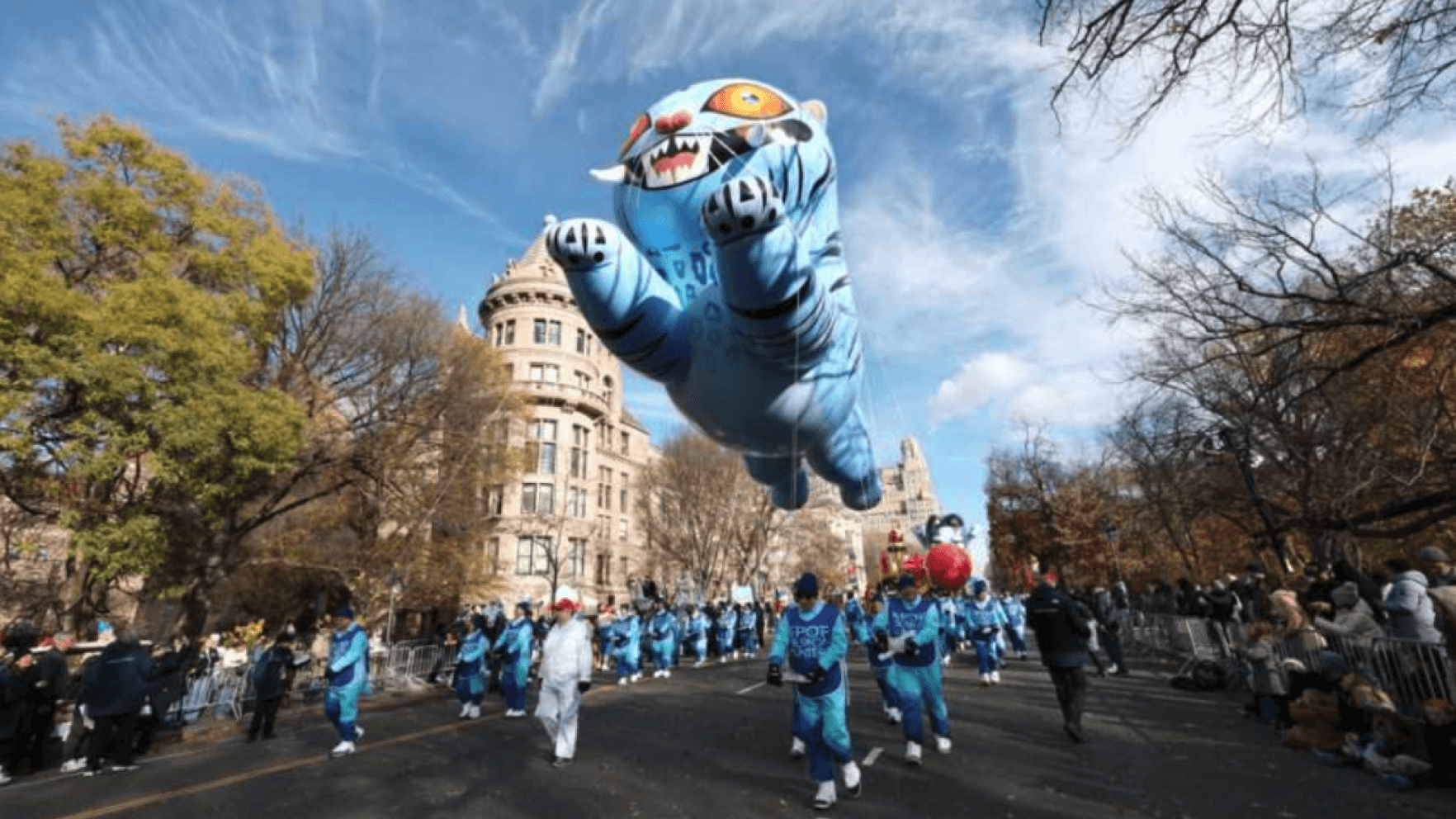
“Derpy,” the signature tiger character from K-Pop Demon Hunters, soaring above the 2025 Thanksgiving Day Parade — the viral moment that ignited a global wave of secondary fan content.
Capturing the Elusive 'Moment of Opportunity'
The explosive reaction to the street-parade live performance of “Golden,” the OST from Netflix’s animated series K-Pop Demon Hunters, during the recent US Thanksgiving Day Parade has created a powerful new marketing opportunity for brands. The performance by HUNTR/X (Ejae, Audrey Nuna, Rei Ami) once again ignited a viral surge across all major video platforms, including YouTube—offering advertisers a rare and decisive “golden time.”
Even before the parade, the OST had already triggered an unprecedented wave of secondary content creation. Top global artists released cover videos, which were then regenerated into countless short-form clips, fueling an explosive rise in fan-made content. Many brands have long tried to convert this kind of cultural momentum into real marketing impact.
However, capturing such opportunities using conventional methods has been virtually impossible. As viral content spreads at high speed, so do associated risks—such as malicious rumors and misinformation. Brands are forced into a difficult dilemma: move quickly to seize the moment, or stay cautious to avoid brand-safety threats.
To overcome this limitation and transform a fleeting viral moment into measurable marketing results, a media-buying strategy powered by video understanding AI becomes essential. The following two case studies from 2025 illustrate how AI-driven video comprehension enables this new approach and accelerates brand growth in an unpredictable digital landscape.
Case Study 1. ‘K-Pop Demon Hunters’ Playbook:
Turning Unpredictable Virality into Performance
A global food company identified a standout scene in the original Netflix animation K-Pop Demon Hunters—a moment where the three HUNTR/X characters joyfully slurp instant cup ramen. This instantly recognizable sequence quickly became one of the signature moments from what would become one of Netflix’s most successful animated releases. Sensing the cultural momentum behind this particular scene, the brand made a bold strategic decision: it secured the costly IP rights with one clear objective—to maximize contextual relevance by running ads exclusively next to positive, fan-driven content related to the show.
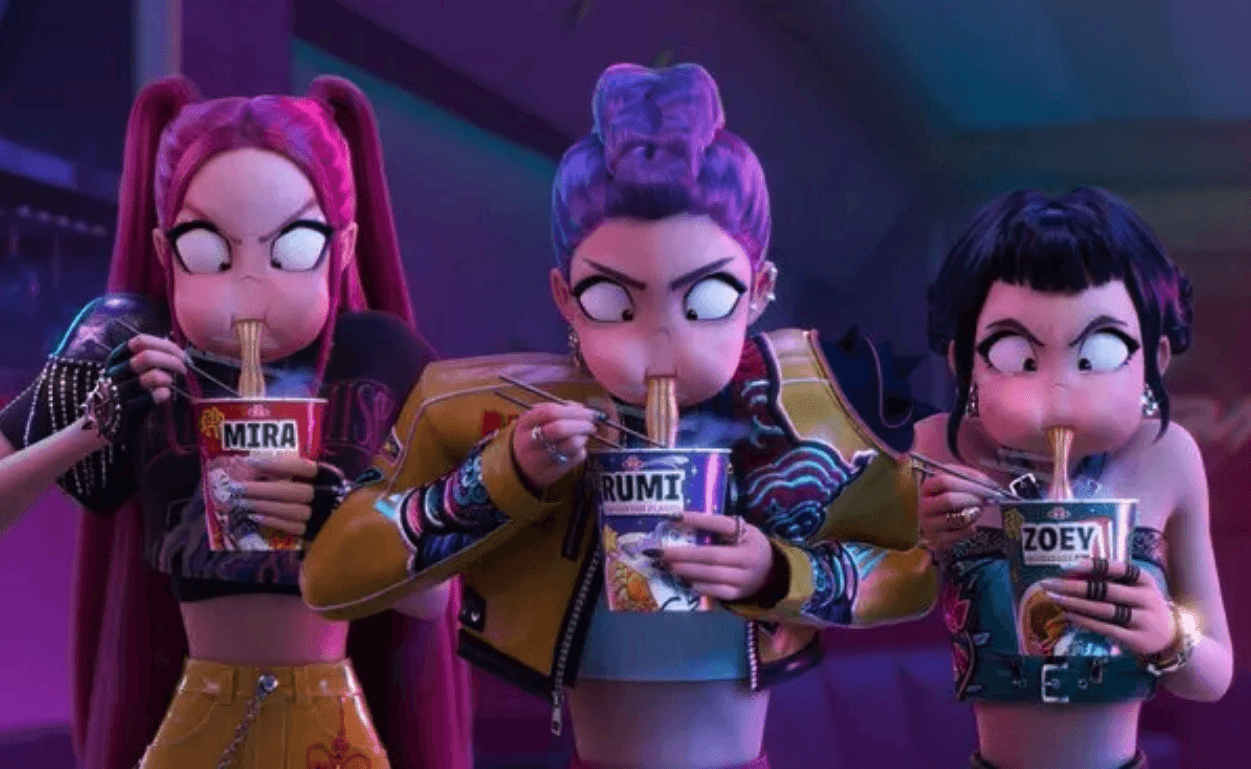
The three HUNTR/X protagonists — Mira, Rumi, and Zoey — in the now-iconic ramen-slurping scene that became the cultural anchor of the animation’s global virality.
As fan-made videos celebrating the animation—and its full OST—flooded YouTube in real time, every song from the movie charted on Billboard, with “Golden” dominating the top ranks for weeks. Manually tracking the daily surge of valuable covers, reviews, and challenge videos was simply impossible. To solve this, the company decided to employ video understanding AI.
The technology automatically identified and placed ads on relevant content in real time, keeping the campaign perfectly synchronized with the IP’s sustained popularity and the soundtrack’s chart performance. By restricting ad delivery to this highly contextual content pool, brand-safety risks were virtually eliminated, and contextual alignment between the ad and the video approached near-perfect levels. This precision was the key to converting a short-term viral explosion into long-term brand equity and measurable sales impact.
This strategy goes far beyond a one-off tactic—it has become an essential engine for translating short-lived viral trends into durable value.
For companies that rely heavily on cultural momentum—such as food & beverage brands, entertainment companies, and any advertisers leveraging IP, PPL, or sponsorships—this approach offers a powerful growth mechanism. By using AI to systematically secure the virtually infinite pool of secondary derivative content generated by IP popularity (e.g., Thanksgiving performance clips, year-end festival videos), brands can maximize contextual relevance between their message and the consumer experience. Over time, this dramatically increases ad receptiveness and boosts conversion into sales.
Case Study 2. The Son Heung-min Phenomenon:
Achieving Opportunity Preemption and Risk Defense in Parallel
The case of Son Heung-min—“Sonny”—who led Tottenham to victory in the 2024–2025 Europa League final, clearly illustrates why AI technology has become essential. Immediately after the win, videos celebrating Sonny’s success story surged across platforms. Yet at the same time, fake news and rumors about his private life spread just as quickly, placing advertisers in a hesitant “golden time” filled with both opportunity and risk.

Son Heung-min lifting the Europa League trophy for Tottenham in the 2024–2025 season — the explosive “golden time” that triggered a massive surge of celebratory and derivative content across platforms.
Video understanding AI resolved this dilemma through real-time, multimodal analysis of the videos. By interpreting facial expressions, audio tone, and on-screen captions together, the system went far beyond simple keyword detection. It accurately identified high-value positive contexts—“victory,” “emotional,” “inspirational”—that signal strong brand suitability.
This enabled advertisers to concentrate their spend on the most emotional, high-impact content pools immediately after the win. Just as importantly, the AI automatically filtered out sensitive cues such as “controversy,” “rumor,” and other negative contexts, effectively blocking harmful placements. In essence, the technology maximized brand safety in an uncertain environment by enabling opportunity preemption while naturally avoiding risk.
A major financial institution featuring Son Heung-min as a brand ambassador, along with a global sports drink company, confirmed that with AI they could seize this golden window within hours. Both brands executed timely campaigns before the excitement cooled, significantly amplifying marketing effectiveness.
Ultimately, this case demonstrates the power of an aggressive growth engine—one that companies must rely on to convert volatile, explosive virality into tangible marketing outcomes. Even as countless videos are uploaded, AI’s real-time analysis pinpoints the most valuable positive contexts and instantly places ads, maximizing sales and awareness when public attention peaks.
At the same time, the strategy enforces brand safety by rigorously excluding negative rumors and controversy, while aggressively capturing positive placement opportunities. It is the most efficient bridge between short-term viral spikes and long-term brand equity in today’s unpredictable digital landscape.
Predictable TV Era vs. the Overwhelming Speed of the Digital Era
In the traditional TV era, fixed programming schedules made “timing” marketing possible—for example, airing a congratulatory ad immediately after a sports star’s victory. But the digital video ecosystem operates on entirely different rules. With nearly 500 hours of video uploaded to YouTube every minute, no brand can predict which content will go viral or when it will happen.
This uncontrollable velocity makes “placement management”—selecting high-quality, positive content while avoiding harmful or risky videos—an operational burden far beyond human capacity. In today’s environment, manually tracking and filtering content is no longer feasible.
Technical Significance
The exponential growth of video platforms has created a critical challenge for brands: ensuring brand safety and brand suitability simultaneously across an overwhelming volume of content. Solving this at scale requires integrating advanced AI technologies—video retrieval, proprietary embedding models, and a robust end-to-end (E2E) pipeline.
Historically, the video advertising market faced what was essentially a technical impossibility. There was no AI infrastructure capable of real-time, large-scale video analysis, making accurate brand-safety and suitability decisions unattainable. To meet rapidly evolving brand requirements and maintain consistent precision, companies must go beyond simply deploying off-the-shelf AI models. True problem-solving demands full ownership of both the models and the entire operational pipeline.
Technical Breakthrough and Innovation
At PYLER, we have broken through this long-standing limitation. By leveraging GPU infrastructure such as the NVIDIA DGX B200 to maximize AI performance, and adopting SingleStore as our real-time data engine, we eliminated bottlenecks in the large-scale collection, analysis, and ad-serving connection of video data. This foundation made it possible to execute scalable video retrieval tasks that were previously out of reach.
Our proprietary video retrieval technology enables both brand suitability and scalable, contextual video search. Video retrieval refers to the ability to precisely identify specific moments or videos that best align with a brand’s contextual criteria—using multimodal signals across visuals, audio, and text.
Most importantly, by integrating our in-house embedding model with a fully owned E2E pipeline, we deliver sophisticated and scalable results that were once considered impossible. In effect, we transform what used to be a “cannot be done” problem into a fully operational capability—an achievement only a few companies worldwide have reached.